
How Track Conditions Impact UK Wheel Bets
 Available in US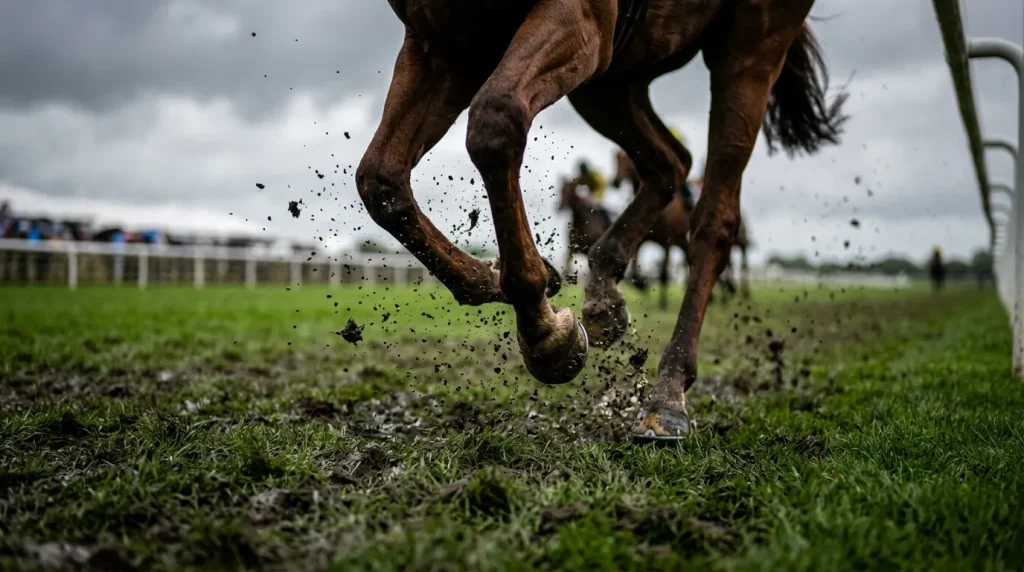
UK Track Conditions: Adjusting Exotic Bets for the Going
Going and track conditions are the single most underrated variable in exotic betting. Firm, good, soft, heavy — four words that describe the state of the ground, and four words that can turn a well-fancied key horse into a non-finisher or promote a 20/1 outsider into the frame. Every wheel bet you build assumes that your key horse will perform. The going determines whether that assumption holds or collapses.
The UK going system is more granular than most international equivalents, reflecting the importance of ground conditions to a racing culture built on natural turf. British racing tests horses on surfaces that change with the weather — sometimes between races on the same card. For the exotic punter, ignoring the going is like building a house without checking the foundations. This guide explains the scale, how it is measured, what it does to race dynamics, and how to factor it into your wheel construction.
The UK Going Scale Explained
The BHA recognises a spectrum of going descriptions for turf racing, running from the fastest surface to the most testing:
Hard. Firm. Good to firm. Good. Good to soft. Soft. Heavy.
Hard ground is rare and generally avoided by racecourses because of the injury risk to horses. Firm is fast and suits speed horses. Good to firm is the default summer surface — quick but with enough give to protect limbs. Good is the universal standard — the going at which most form comparisons are considered reliable. Good to soft introduces moisture that changes stride patterns and favours horses with stamina. Soft demands genuine staying power and punishes horses that rely on a fast surface. Heavy is testing in the extreme — deep, energy-sapping ground that some horses relish and others cannot handle.
GoingStick Readings
Since 2007, UK racecourses have used the GoingStick — an electronic penetrometer — to supplement traditional descriptions with objective measurements. The GoingStick produces a reading on a numerical scale, typically ranging from around 4.0 (heavy) to 14.0+ (firm). The reading is taken at multiple points across the course and an average is published alongside the official going description. GoingStick readings provide consistency that subjective descriptions sometimes lack, and they are published on the BHA website and on Racing Post racecards before every meeting.
All-Weather Surfaces
Britain has six all-weather tracks: Chelmsford, Kempton, Lingfield, Newcastle, Southwell and Wolverhampton. These synthetic surfaces — Polytrack at Chelmsford, Kempton and Lingfield, and Tapeta at Newcastle, Southwell and Wolverhampton — are largely unaffected by weather. The going on all-weather tracks is generally described as “standard” or “standard to slow” and varies far less than turf. For exotic punters, all-weather racing removes the going variable almost entirely, which simplifies key horse selection but also means fewer opportunities for going-related value bets that the market has mispriced.
Of the 21,728 horses in training in Britain during 2025, as recorded by the BHA Racing Report, a significant proportion are trained with specific going preferences in mind. Trainers choose racecourses and entries based on expected ground conditions, and horses with known going preferences are often withdrawn if the ground changes overnight. Understanding this dynamic helps exotic punters anticipate likely non-runners and adjust their wheels accordingly.
How Going Changes Race Dynamics
The going does not just slow horses down or speed them up — it changes the entire character of a race. Three dynamics shift as the ground softens.
Pace and Stamina
On firm ground, races are run faster. Frontrunners can dictate and hold their position because the surface offers minimal resistance. On soft and heavy ground, the pace drops, the energy cost per stride increases, and the race becomes a test of stamina rather than speed. Horses that sit behind the pace and finish strongly — closers — gain an advantage on softer ground because the frontrunners tire earlier. For wheel bets, this means the likely finishing order changes with the going. A horse that dominates on firm ground by leading from the front may struggle to hold its position when the ground turns soft, and a closer that is typically outpaced early may find itself running on strongly past tiring rivals.
Draw and Positioning
Soft ground can amplify draw biases on certain courses. When the rail is on waterlogged ground and the centre of the track is firmer, horses drawn wide gain an advantage because they avoid the worst of the surface. Conversely, on drying ground where the rail is the fastest strip, low draws benefit. Checking the going in conjunction with draw data doubles the analytical power of your wheel selection process.
Horse Preferences
Some horses are dramatically better on specific ground. A horse with a form record of 1-2-1 on soft ground and 8-7-6 on firm is not the same animal on different surfaces — and its market price often fails to capture the full extent of that difference. The market tends to price horses on recent form without adequately discounting for going conditions. This creates systematic value for the exotic punter who checks going records and identifies horses whose true ability on today’s surface is higher than their overall form suggests.
Using Going Data to Sharpen Your Wheel
The practical application of going data flows through two channels: key horse selection and partial wheel construction.
Key Horse Adjustment
Before committing to a key horse, check its form filtered by today’s going. Racing Post and Timeform both allow you to view form figures broken down by going category. If your intended key horse has never won on soft ground and today’s going is soft, that is a red flag. Favourites across UK racing win 30 to 35% of the time, dropping to approximately 25.7% in handicaps, but that figure drops further when a well-backed horse faces unfamiliar ground conditions. A key horse on its preferred going is structurally more reliable than one facing an untested surface.
Partial Wheel Filtering
Use going records to exclude runners from your partial wheel. In an eight-runner race, if two runners have zero wins from a combined twelve starts on today’s going, excluding them costs you nothing in realistic coverage and saves two units of stake. Over a full afternoon of racing, those exclusions compound into meaningful savings and a tighter, more defensible set of combinations.
Check the going report as close to race time as possible. Ground conditions can change during the day — a shower of rain between the second and third race can shift the going from good to good-to-soft, and that shift may invalidate your key horse choice or bring an excluded runner back into consideration. Flexibility is the exotic punter’s friend. Be willing to abandon a pre-planned wheel if the going changes against your selections rather than stubbornly holding a position that the ground no longer supports.
The Ground Beneath the Bet
Going and track conditions are not background noise — they are a primary input into every wheel bet decision. The going determines which horses will handle the surface, which will struggle, and which are being systematically mispriced by a market that tends to underweight ground preferences. Checking the going, cross-referencing it with form, and adjusting your key horse and partial wheel accordingly is a habit that costs nothing and delivers a measurable edge over punters who ignore it.
Sources
- BHA — 2025 Racing Report, horses in training and industry data: britishhorseracing.com
- Grand National Fans — favourite win rates in UK racing, BHA data: grandnational.fans
