
Full Wheel vs Partial Wheel: Optimising Your Wagers
 Available in US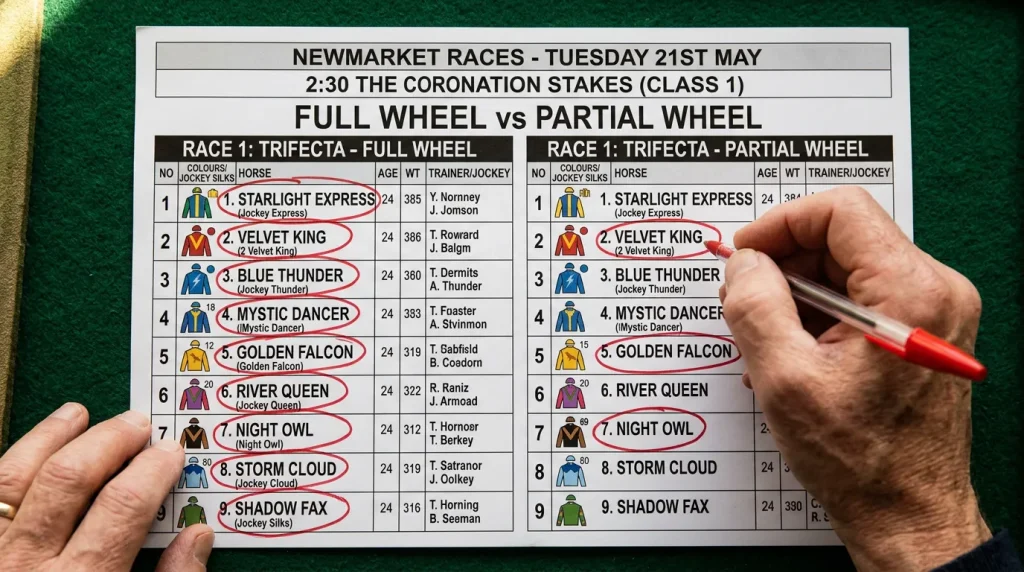
A full wheel bet is the broadest net you can cast in exotic horse racing wagering — and for plenty of punters, it is also the most expensive lesson they never planned to pay for. The concept is straightforward: you lock in a key horse for one finishing position and pair it with every other runner in the field. No filtering, no judgement calls on the supporting cast. The full wheel does the thinking for you, at a price.
Its counterpart, the partial wheel, flips that logic. Instead of covering every conceivable combination, you handpick a smaller group of horses to rotate around the same key selection. Fewer combinations, lower outlay, sharper focus. The trade-off is obvious — miss a runner you excluded and the bet is dead regardless of how well your key horse performs.
Choosing between full and partial wheel bets is not a matter of temperament or budget alone, though both play a role. It is a structural decision that hinges on the race in front of you: the size of the field, the competitiveness of the runners behind your key horse, and the type of exotic you are constructing. A full wheel on an eight-runner conditions race at Newmarket is a completely different proposition from a full wheel on a sixteen-runner handicap at York. The maths changes, the risk profile changes, and the expected value shifts in ways that are easy to miss if you treat all fields as equal.
This guide breaks down both modes in detail. We will walk through the mechanics of each, lay out cost scenarios for real UK field sizes, build a decision framework you can apply at the racecourse or on your phone, and explore the edge cases — multi-key wheels, pyramid structures — that sit between the two extremes. By the end, you should be able to look at any race card and know which type of wheel deserves your money.
If the cost of a full wheel is too high, you should read our comparison of wheel bet vs box bet to find a cheaper option.
Full Wheel Bets: Covering Every Runner on UK Tracks
The full wheel is the simplest exotic structure to understand. You select one horse — your key — and fix it in a specific finishing position. Then the bet automatically pairs that key horse with every other runner in the race for the remaining position or positions. In an exacta (or forecast, in UK terminology), if you wheel your key horse on top, it must finish first while every other horse individually occupies second place across separate combinations. You end up with as many individual bets as there are other runners in the field.
The formula for a full exacta wheel is clean: (n − 1) × stake, where n is the total number of runners. In an eight-runner race at a £1 base stake, that gives you seven combinations costing £7. In a twelve-runner handicap, you are looking at eleven combinations and an £11 outlay. Move to a trifecta (tricast) full wheel with one key horse fixed in first, and the formula shifts to (n − 1) × (n − 2) × stake. That same eight-runner field now produces 42 combinations at £42 for a £1 unit. The twelve-runner handicap jumps to 110 combinations — £110 before your key horse has even left the stalls.
According to the BHA’s 2025 Racing Report, the average field size on the Flat in Britain stood at 8.90 runners, dipping from 9.14 the previous year. For Premier fixtures — the meetings that draw the strongest cards — that average rose to 11.02. These are not abstract numbers; they are the raw inputs that determine what a full wheel will cost you on any given afternoon. A punter who instinctively reaches for the full wheel without checking the field size is handing the bookmaker a blank cheque.
The visual logic of a full wheel is worth holding in your mind. Picture an eight-runner race with your key horse, Horse A, fixed to win. A full exacta wheel generates these combinations: A-B, A-C, A-D, A-E, A-F, A-G, A-H. Seven bets. If Horse A wins and any of those seven runners finishes second, you collect. You do not need to have an opinion on which of those seven is likeliest to fill the runner-up spot. That is the beauty of the full wheel — and its limitation. You are paying the same amount for the combination featuring the rank outsider at 66/1 as you are for the second-favourite at 3/1.
When does a full wheel make sense? In two broad scenarios. First, when you have exceptional confidence in your key horse but genuinely cannot separate the rest of the field. This happens more often than seasoned punters like to admit — competitive handicaps, races with an unexposed improver at the top of the market, or fields where form is unreliable because of a change in going. Second, when the field is small enough that the total cost remains manageable. A full exacta wheel in a six-runner race costs just £5 at a £1 base. That is cheaper than most each-way bets. In those situations, the full wheel is not extravagance; it is economy.
The danger emerges in larger fields. A full trifecta wheel with one key in a sixteen-runner race produces 210 combinations at £1 per unit — a £210 bet on a single race. Unless the expected trifecta dividend is significantly larger than that outlay, the value disappears quickly. This is where many punters burn through their bankroll: they apply a strategy designed for compact fields to sprawling handicaps without adjusting the structure.
Partial Wheel: Targeting Your Selections
A partial wheel keeps the same core architecture — one key horse locked into a finishing position — but replaces the blanket coverage of a full wheel with selective inclusion. Instead of pairing your key with every other runner, you choose a subset: the three, four, or five horses you believe have a realistic chance of filling the supporting positions. Everyone else in the field is excluded from the bet.
The cost reduction is immediate and significant. Take that same eight-runner race. A full exacta wheel costs £7 at £1 per unit. A partial exacta wheel using your key horse plus three selected runners costs just £3. You have cut your outlay by more than half. The savings compound as you move to trifecta structures. In a twelve-runner field, a full trifecta wheel with one key costs £110. A partial trifecta wheel selecting five supporting horses for second and third drops to 5 × 4 = 20 combinations, or £20. That is an 82% saving — but it demands that two of your five selected runners fill the minor placings alongside your key.
The partial wheel, then, is a bet on your own judgement. The full wheel asks only one question: will the key horse finish in the designated position? The partial wheel asks two: will the key horse finish where expected, and were you right about which other horses belong in the frame? That second question is harder than it sounds.
Data from British racing suggests that favourites win approximately 30 to 35 per cent of races across all codes, according to analysis of BHA race results published by Grand National Fans. In handicap races — the bread and butter of UK afternoon cards — that figure drops to around 25.7 per cent. If the market favourite only obliges a quarter of the time in handicaps, the second and third favourites are hardly more reliable. This is why partial wheel construction requires genuine form reading, not just a glance at the betting market. You need to identify horses with a realistic chance of placing, and sometimes those runners sit deeper in the market than the obvious names at the top of the racecard.
How do you decide which horses make the cut? Start with form. Look at runners with recent placed efforts at the same class and distance, preferably on similar going. Factor in trainer and jockey combinations that perform well at the track. Then consider the race dynamics: front-runners in a contest with no early pace might overperform their odds, while hold-up horses in a slowly-run affair can find themselves with too much ground to make up. The goal is not to find the winner — you have already committed to your key horse for that — but to identify the horses likeliest to fill the supporting positions.
A practical rule of thumb for partial wheel sizing: in fields of eight to ten runners, selecting three to four supporting horses usually provides enough coverage without overinflating the cost. In fields of twelve to sixteen, four to six selections strikes a balance between coverage and economy. Go beyond that, and you start to lose the cost advantage that makes the partial wheel attractive in the first place.
One underappreciated aspect of partial wheels is that they force discipline. The full wheel is passive — you press a button and cover everyone. The partial wheel requires you to eliminate runners, which means engaging with the form and the race conditions in a way that casual punters often skip. That engagement, over time, tends to make you a sharper judge of racing. Whether it makes you a more profitable one is another question entirely, but it certainly makes you a more thoughtful one.
Cost Showdown: Full vs Partial in Real Pounds
Numbers settle arguments that intuition cannot. Below are cost breakdowns for full and partial wheels across three field sizes that reflect real UK racing: an 8-runner conditions race, a 12-runner handicap, and a 16-runner Premier fixture — the kind you would encounter at Ascot, York, or Newbury on a big Saturday. All figures use a £1 base stake unless otherwise noted.
Exacta (Forecast) Wheel Costs
For an exacta wheel with one key horse fixed in first place, the full wheel formula is (n − 1) × £1. The partial wheel assumes four selected supporting runners.
| Field Size | Full Wheel (£1) | Partial Wheel — 4 selections (£1) | Saving |
|---|---|---|---|
| 8 runners | £7 | £4 | 43% |
| 12 runners | £11 | £4 | 64% |
| 16 runners | £15 | £4 | 73% |
At the exacta level, the full wheel remains affordable even in larger fields. Fifteen pounds for a 16-runner full exacta wheel is not going to wreck most bankrolls. The partial wheel holds steady at £4 regardless of field size — your cost is determined by how many runners you include, not how many are in the race. This fixed-cost property is one of the partial wheel’s strongest selling points.
Trifecta (Tricast) Wheel Costs
Trifecta wheels escalate quickly. The full wheel formula with one key horse in first is (n − 1) × (n − 2) × £1. The partial wheel assumes five selected supporting runners for positions two and three.
| Field Size | Full Wheel (£1) | Partial Wheel — 5 selections (£1) | Saving |
|---|---|---|---|
| 8 runners | £42 | £20 | 52% |
| 12 runners | £110 | £20 | 82% |
| 16 runners | £210 | £20 | 90% |
The gap between full and partial widens dramatically as fields grow. In a 16-runner race, the full trifecta wheel costs more than ten times the partial. At £2 per unit — a common stake for punters chasing meaningful returns — the full wheel in that field becomes £420. Meanwhile the partial stays at £40. The practical implication is clear: full trifecta wheels in fields beyond about ten runners are a luxury reserved for punters with large session budgets or those who have a specific reason to believe the trifecta payout will be enormous.
The UK Tote applies a 25 per cent deduction to both Exacta and Trifecta pools before dividends are calculated — higher than the roughly 16 to 20 per cent takeout typical of US win and exotic pools, as Covers’ pari-mutuel guide notes for North American tracks. In practical terms, your £210 full trifecta wheel is competing against a pool that has already been reduced by £52.50 worth of invisible drag. The BHA’s 2025 data showing average Flat field sizes of 8.90 runners offers a useful baseline: at that typical field size, a full trifecta wheel costs £56, which remains within reach for a disciplined punter. It is only when fields push past twelve that the economics begin to turn hostile.
Double the Stake, Double the Question
Many punters instinctively move to a £2 base stake for exotic bets, reasoning that a £1 trifecta payout is rarely worth the effort. Fair enough — but doubling the stake doubles every figure in the tables above. A £2 full trifecta wheel on a 12-runner field is £220. The same structure as a partial with five selections is £40. Before committing to a higher base stake, always calculate the total cost of the wheel first. It takes five seconds and saves a good deal of regret.
When Full Wheel Wins — And When Partial Saves Your Bankroll
Choosing between full and partial wheel bets is not a philosophical debate — it is a set of practical questions you can answer before the race goes off. Here is a decision framework built around four variables: race type, confidence in your key horse, field size, and session budget.
Race Type: Handicap vs Conditions
Conditions races (including Group and Listed events) tend to have smaller, more predictable fields. The class gaps between runners are often wider, meaning the form book gives you clearer signals about which horses belong in the frame. In these races, a partial wheel is usually the right call. You can identify three or four legitimate contenders with reasonable confidence and exclude the rest without losing sleep.
Handicaps are the opposite. The handicapper’s job is to compress the field, giving every runner a theoretical chance. The result is more unpredictable finishing orders and a higher frequency of longshot places. Handicap races are where full wheels earn their keep — particularly at the exacta level, where the cost stays manageable. If you genuinely cannot separate eight horses for the runner-up spot behind your key, the full wheel acknowledges that uncertainty honestly.
The BHA’s figures reinforce this split. The number of horses in training across Britain has continued to decline — 21,728 in 2025, a 2.3 per cent drop from 2024, per the BHA Racing Report. Shrinking horse populations mean smaller fields on average, but the races that do attract large entries tend to be handicaps. The gap between a six-runner Group 3 and a sixteen-runner heritage handicap has never been wider in terms of wheel bet economics.
Confidence in the Key Horse
The strength of your key horse selection should directly influence the wheel type. If your key is a short-priced favourite with strong recent form on the prevailing ground, you can afford to invest more in the wheel because the probability of the key fulfilling their part of the bargain is higher. That extra investment might mean a full wheel on a medium-sized field or a wider partial wheel covering six or seven runners in a large field.
If the key horse is a speculative pick — perhaps a horse returning from a break, dropping in class, or racing on an untested surface — the partial wheel becomes the safer vehicle. You are already taking a risk with the key; there is no need to compound it by paying full-wheel prices on the supporting positions. Keep the outlay tight and accept that the bet has a lower probability of landing but a more favourable cost-to-potential-payout ratio.
Field Size
This is the single most important variable for trifecta and higher-order wheels. The cost tables in the previous section tell the story, but here is the rule distilled: for fields of eight or fewer, full wheels are almost always viable. For fields of nine to twelve, full exacta wheels remain reasonable but full trifecta wheels start to stretch. For fields of thirteen or more, partial wheels should be the default unless your bankroll can absorb a large outlay on a single race.
Session Budget
Every exotic bettor should set a session budget before the first race. A useful guideline is to allocate no more than 2 to 5 per cent of your total betting bankroll to any single exotic bet. If your session budget is £50 and you are eyeing a full trifecta wheel that costs £110, the answer is already clear — you need to switch to a partial. Discipline here is not glamorous, but it is the difference between lasting a full card and going bust by the third race.
As the legendary trainer John Gosden once observed, gambling on horse racing “requires deep research, a high degree of knowledge and understanding of a host of factors including form, going, draw, distance, pedigrees, jockey and trainer.” That depth of analysis applies to every decision in exotic betting, including the structural choice between full and partial wheels. Treat the decision as part of your handicapping process, not an afterthought, and you will consistently make better calls about where your money goes.
Edge Cases: Multi-Key Wheels and Pyramid Structuring
Full and partial are the two modes most punters encounter, but wheel betting has a few structural variations that sit between them. Understanding these edge cases can unlock better value in specific situations, particularly in trifecta and higher-order exotics.
Multi-Key Wheels
A standard wheel uses one key horse. A multi-key wheel uses two — or occasionally three — horses locked into designated finishing positions, with the remaining positions filled by a rotating cast. The classic setup is a two-key trifecta wheel: Key Horse A is fixed in first, Key Horse B is fixed in second, and all other selected runners rotate through third place.
The cost advantage is substantial. In a twelve-runner field with one key in first and five selections for second and third, a partial trifecta wheel costs 5 × 4 = 20 combinations at £1. But if you are confident enough to fix two keys — one in first, one in second — and rotate ten remaining runners through third, the cost is just 10 combinations at £1. You have halved the outlay while retaining coverage of every runner for the third-place slot.
The catch is obvious. You now need two horses to finish in exact positions, not one. If Key Horse B finishes third instead of second, the entire bet collapses. Multi-key wheels are therefore best reserved for races where you have strong opinions about the first two home — perhaps a two-horse market where the top pair are significantly clear of the rest on form. They work particularly well in small-field conditions races and Grade 1 events where the class gap narrows the realistic contenders to a handful.
Pyramid Structuring
Pyramid structuring is a technique for trifecta and superfecta wheels that allocates more runners to later positions and fewer to earlier ones. The logic mirrors how confidence typically degrades as you move further down the finishing order: you are most certain about the winner, reasonably confident about second, less sure about third, and your conviction about fourth (in a superfecta) is largely guesswork.
A pyramid trifecta might look like this in a fourteen-runner race: one key horse in first, three selections for second, and six selections for third. The combination count is 3 × 6 = 18 at £1, compared to 13 × 12 = 156 for a full wheel. You have cut the cost by nearly 90 per cent while concentrating your exposure where your judgement is strongest.
The effectiveness of pyramid structuring depends on disciplined selection at each level. The three horses you choose for second place need to be genuine contenders, not just names you vaguely recognise. The six for third can be a wider net — this is where you might include a roughie or two — but they should still have some basis in form, track record, or race dynamics. A pyramid built on guesswork is just a more complicated way to lose money.
Part-Wheeling Multiple Positions
A related variant involves part-wheeling different groups of horses in different positions, without fixing any single horse as a key. For example, you might assign three horses to first place, four horses to second, and six to third in a trifecta. The cost is 3 × 4 × 6 = 72 combinations at £1, and no individual horse is required to finish in a specific spot. This structure functions more like a box bet with uneven weightings and is sometimes called a “structured box” or “weighted combination.” It sits outside the traditional wheel framework — there is no key horse — but it uses the same combinatorial logic and can be constructed on most UK pool betting platforms.
These edge cases are not everyday tools. Most punters will find that the standard full-or-partial choice covers 90 per cent of situations. But knowing they exist gives you flexibility when the race conditions call for something less conventional — and in exotic betting, flexibility is a quiet advantage.
Conclusion
Full and partial wheel bets are not competing philosophies — they are tools for different jobs. The full wheel suits small to medium fields where you trust your key horse but cannot separate the supporting runners. The partial wheel suits larger fields, tighter budgets, and situations where your form analysis gives you a defensible opinion on which horses belong in the frame and which do not.
The decision between them comes down to four questions: how big is the field, how confident am I in the key horse, what type of race is this, and what can I afford to spend? Answer those honestly, run the cost calculation, and the choice usually makes itself. If it does not, start with a partial wheel. It is always cheaper to add a runner you missed than to pay for twenty you never needed.
Whether you reach for a full wheel, a partial, or one of the edge-case structures like a pyramid or multi-key, the underlying principle stays the same. Every combination in your bet should be there for a reason. The moment you stop asking “why this runner?” is the moment you stop betting and start buying lottery tickets.
Learn more about maximizing your coverage on our horse racing wheel betting homepage.
Sources
- British Horseracing Authority — 2025 Racing Report (field sizes, horses in training)
- Grand National Fans — How Often Do Favourites Win (favourite win-rate data)
- Covers — Pari-Mutuel Betting Guide (US takeout rates)
- UK Tote — Totepool Rules (UK pool deduction rates)
- Arena Racing Company — British Horseracing Voices Major Concerns (John Gosden quote)
