
Proven Wheel Betting Strategies for UK Horse Racing
 Available in US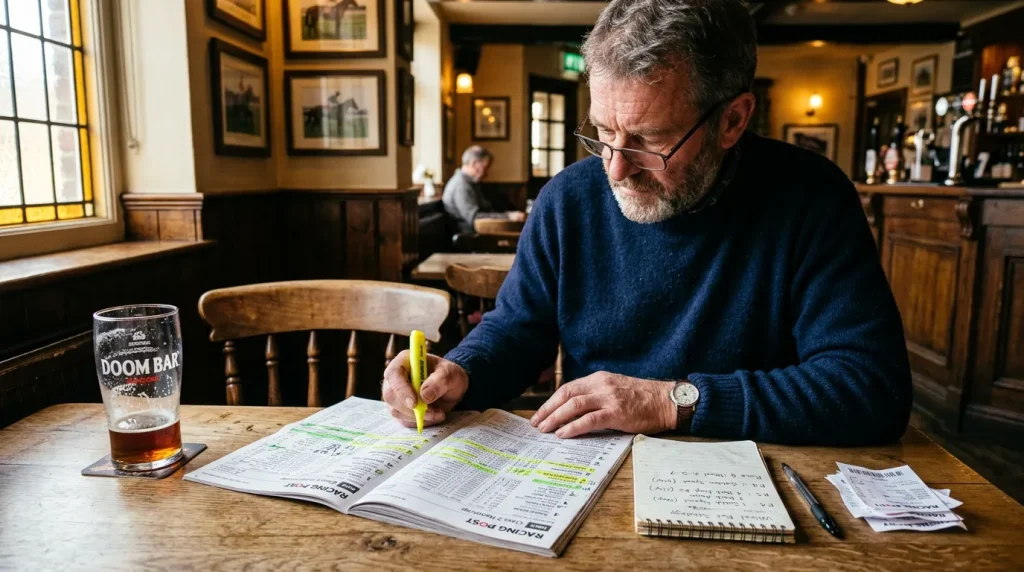
Wheel bet strategy is what separates a structured wager from an expensive lottery ticket. Without a method for choosing the key horse, sizing the wheel, and managing the bankroll, exotic bets become a fast route to an empty account — and the market data backs this up. British horse racing betting turnover has been declining year on year, with the total falling to £8.73 billion in FY 2023/24, and punters who treat exotic bets as casual punt-and-hope exercises are contributing to the wrong side of that ledger.
The good news is that strategic wheel betting does not require proprietary software or inside connections. It requires a disciplined approach to three fundamentals: selecting a reliable key horse through genuine form analysis, understanding how field size affects the economics of your bet, and applying bankroll rules that keep you in the game across a full racing season. These are not secrets. They are principles that any punter can learn and apply — the challenge is consistently doing so when the temptation to wing it is ever-present.
This guide provides a data-backed strategic framework for wheel betting on UK horse racing. Each section targets a specific decision point: which horse to anchor your wheel around, how the size and type of race should shape your wheel structure, how to protect your bankroll from the volatility inherent in exotic bets, and the most common pitfalls that drain money from even experienced exotic punters.
To avoid overspending on your wagers, always use a wheel bet cost calculator before confirming your ticket.
Key Horse Selection: Analysing Form, Class and Going
Your key horse is the load-bearing wall of every wheel bet. If it fails, every combination in the bet collapses — it does not matter how brilliantly you selected the supporting runners. This makes key horse selection the single highest-leverage decision in exotic wagering, and it deserves more analytical rigour than most punters give it.
Start with recent form. In UK racing, the form figures printed beside a horse’s name — the sequence of finishing positions in its last six runs — are the first filter. A horse showing figures like 211321 has been consistently competitive. One showing 078060 has not. But form figures alone tell a partial story. The question is not just where the horse finished but against whom, at what class, on what ground, and over what distance. A horse that finished third in a Group 2 at Ascot is a fundamentally different prospect from one that finished third in a Class 5 handicap at Catterick.
Class is the great clarifier. UK racing operates a class hierarchy from Group 1 at the top to Class 7 at the bottom, with handicaps assigned an Official Rating band. A horse dropping in class — say, from a Class 2 to a Class 4 handicap — is taking on weaker opposition and, all else being equal, has an improved chance of finishing in the positions your wheel requires. Conversely, a horse rising in class faces a sterner test and carries more risk as a key selection.
Going — the official description of track conditions — is the third pillar. Some horses thrive on fast ground and struggle in the mud. Others are at their best when the rain arrives. The UK going scale runs from Firm through Good to Firm, Good, Good to Soft, Soft, and Heavy, with additional descriptions for all-weather surfaces. A key horse with proven form on the prevailing going is a materially safer selection than one racing on an untested surface. Check the horse’s going record in its form profile before committing it as your anchor.
Data from British racing underlines why this analysis matters. Favourites win approximately 30 to 35 per cent of all races across Flat and National Hunt, according to analysis of BHA results compiled by Grand National Fans. In handicap races, that figure drops to around 25.7 per cent. The market favourite — the horse the public collectively rates as the most likely winner — fails to oblige in roughly two-thirds of all races. If the best-backed horse in the race loses that often, choosing your key horse on the basis of price alone is a strategy with a built-in failure rate above 65 per cent.
The trainer John Gosden captured this reality when he argued that gambling on horse racing “requires deep research, a high degree of knowledge and understanding of a host of factors including form, going, draw, distance, pedigrees, jockey and trainer.” That depth of analysis is not optional for exotic betting — it is the entry requirement. A key horse selected through genuine form study, class assessment, and going analysis will outperform one selected on instinct, name recognition, or jockey popularity over any meaningful sample size.
Field Size and Its Effect on Wheel Economics
Field size is the variable that most directly controls the cost of a wheel bet, and it is the one that punters most often ignore. The relationship is not linear for trifecta and superfecta wheels — it is multiplicative. Adding two runners to a twelve-runner field does not increase your trifecta wheel cost by a modest increment; it pushes it from £110 to £182 on a full wheel, a 65 per cent jump. Understanding this cost curve is essential for strategic wheel betting.
The BHA’s 2025 Racing Report provides the baseline data. Average field sizes on the Flat stood at 8.90 runners in 2025, down from 9.14 the previous year. For Premier fixtures — the flagship meetings at tracks like Ascot, York, and Goodwood — the average rose to 11.02. These figures tell you what a “typical” field looks like, but the range within a single afternoon card can be enormous. A Saturday at York might feature a five-runner Group 1 alongside a twenty-runner heritage handicap. The strategic wheel bettor does not apply the same structure to both.
The declining number of horses in training across Britain — 21,728 in 2025, a 2.3 per cent reduction from the year before, per the BHA Racing Report — has a cascading effect on field sizes. Fewer horses in the system means smaller entries for lower-tier fixtures, which in turn means lower wheel bet costs for those races. The paradox is that the races with the largest fields — the premium handicaps and festival events — are the ones that generate the biggest exotic dividends, but also the ones where wheel costs become prohibitive without careful structuring.
The Sweet Spot
For trifecta wheels, the economically comfortable zone is eight to twelve runners. At eight runners, a full single-key trifecta wheel costs £42 at a £1 stake — manageable for most session budgets. At twelve runners, the same wheel costs £110. Beyond twelve, the cost rises steeply enough that partial wheels become not just advisable but necessary. At sixteen runners, a full trifecta wheel hits £210; at twenty, £342.
For exacta wheels, field size is less of a constraint. Even in a twenty-runner field, a full exacta wheel costs just £19 at a £1 stake. This makes the exacta wheel the go-to exotic for large fields where you want broad coverage at a controlled price.
The strategic implication: match your wheel type to the field size. Use exacta wheels when fields are large and your budget is tight. Use trifecta wheels when fields are in the eight-to-twelve sweet spot. Save superfecta and higher-order wheels for special occasions — festival handicaps, the Grand National — where both the field size and the potential payout justify the investment, and always use partial or pyramid structures for those.
Bankroll Discipline for Exotic Punters
Exotic bets are high-variance wagers. You will lose more often than you win — that is the mathematical reality of trying to predict multiple finishing positions in a horse race. The question is not whether losing runs will happen but whether your bankroll can survive them long enough for the inevitable winning bets to compensate. The answer depends entirely on how you manage your money.
The broader UK horse racing betting market offers a cautionary backdrop. Total betting turnover on British racing fell to £8.73 billion in FY 2023/24, representing a 16.3 per cent decline compared to 2021/22, according to Racing Post analysis of Gambling Commission data. Adjusted for inflation, the real decline reached approximately 26 per cent — roughly £3 billion of lost turnover in three years. Part of this reflects regulatory headwinds, part reflects punter attrition. Exotic bettors who fail to manage their bankroll are among those who drop out earliest, because the cost per bet is higher and the losing streaks feel sharper.
The Percentage Method
A straightforward approach: allocate 2 to 5 per cent of your session bankroll to any single exotic bet. If your session bankroll is £200, your maximum stake on one wheel bet is £4 to £10. If your bankroll is £500, the ceiling is £10 to £25. This percentage-based approach automatically scales your exposure to your bankroll size. When you are winning and the bankroll grows, your bet sizes grow proportionally. When you are losing and the bankroll shrinks, your stakes contract, slowing the rate of decline.
For exotic bets specifically, many experienced punters keep a separate exotic bankroll — a ring-fenced amount dedicated to forecasts, tricasts, and wheel bets, distinct from their main betting bank used for win and each-way wagers. The reasoning is that exotic bets have a fundamentally different variance profile: fewer winners, but larger payouts when they land. Mixing exotic stakes with a standard betting bankroll can create a distorted picture of performance, and it tempts punters to chase exotic losses with money that should be allocated to more predictable bet types.
Session Limits
Before the first race on any card, set a session limit — the total amount you are willing to lose on exotic bets that afternoon. If you reach the limit, stop. No chasing, no “just one more.” This is not psychological advice; it is mathematical hygiene. Chasing losses with progressively larger exotic bets is the fastest way to destroy a bankroll because each losing bet increases the size of the next one, compounding the drawdown at an accelerating rate.
A practical session structure: divide your session budget across the number of races where you plan to place exotic bets. If your budget is £50 and you have identified three races suitable for wheel bets, allocate roughly £15 to £17 per race. If the first two bets lose, you still have budget for the third. If all three lose, you are down £50 — not £150 — and you live to bet another day.
Matching Wheel Type to Race Type
Not every race is suited to the same exotic structure. The distinction between Flat and National Hunt racing, between handicaps and conditions races, and between Premier and Core fixtures all affect the optimal wheel approach. Treating these categories identically is a strategy error that costs money over time.
Flat vs National Hunt
Flat racing tends to produce smaller fields, particularly at conditions and Group level. Smaller fields mean lower wheel costs and more predictable results — exactly the conditions where exacta and short-field trifecta wheels thrive. National Hunt racing, by contrast, features larger average fields (especially in handicap hurdles and chases) and introduces additional variables: jumping ability, stamina over longer distances, and the attrition caused by falls and unseated riders. These factors make finishing positions harder to predict, which is bad for straight forecasts but good for wheel-style coverage that profits from unpredictability.
Handicaps vs Conditions Races
Conditions races — where entry is based on age, sex, or prior achievement rather than an allocated weight — typically feature fewer runners and wider class gaps. The best horse in the field often wins, and the form book is a relatively reliable guide. For these races, a narrow partial wheel or even a straight forecast makes sense: you can identify the key horse with reasonable confidence and limit your supporting selections to two or three genuine contenders.
Handicaps are designed to compress the field. The handicapper assigns weights to give every runner a theoretical chance, and the result is a more open contest with a lower favourite strike rate. Data from BHA results shows favourites winning only about 25.7 per cent of handicaps — roughly one in four. In these races, wider wheels are justified because the finishing positions behind your key horse are genuinely uncertain. A full exacta wheel on a twelve-runner handicap costs £11 and covers that uncertainty at a reasonable price.
Premier vs Core Fixtures
The BHA classifies British fixtures into tiers, with Premier meetings (Ascot, Cheltenham, Epsom, York) at the top and Core meetings filling the midweek calendar. The distinction matters for exotic betting in two ways. First, Premier fixtures draw larger fields — the 2025 BHA Racing Report recorded average Premier Flat field sizes of 11.02, compared to 8.90 overall. Larger fields mean higher wheel costs but also bigger potential dividends. Second, Premier meetings attract deeper Tote pools, including World Pool coverage on many occasions, which can meaningfully improve Tote Exacta and Trifecta payouts.
The BHA’s Q1 2025 data, reported in the Racing Report, revealed a telling split: average turnover per race on Core fixtures fell by 14.4 per cent year on year, while Premier fixture turnover held steady. The betting market is increasingly concentrated on the flagship meetings, which means pool liquidity — and therefore pool dividend quality — is concentrating there too. For exotic punters, this reinforces the case for focusing wheel bets on Premier meeting handicaps where the pools are deepest and the fields are largest.
Five Strategic Pitfalls That Drain Exotic Bankrolls
Even punters who understand the strategic framework fall into recurring traps. These five are the most common, and each one is avoidable with a small amount of pre-bet discipline.
Overloading Runners in a Partial Wheel
The point of a partial wheel is to reduce cost by excluding runners you do not fancy. But some punters cannot resist adding “just one more” to the selection, gradually inflating the partial wheel until it is only marginally cheaper than a full wheel. If you find yourself including eight runners in a twelve-runner field, you are not being selective — you are paying full-wheel prices with a partial-wheel self-image. Set a cap before you look at the race: three to five supporting selections for most fields, and hold yourself to it.
Anchoring on a Weak Key Horse
The key horse carries the entire bet. Selecting a key on the basis of name recognition, jockey popularity, or a tip from a friend is not strategy — it is hope wearing a disguise. Every key horse should pass a basic due-diligence checklist: recent competitive form, suitability for the class and distance, a positive record on the going, and no obvious red flags like a first-time visor or a new stable. If a horse cannot pass all four criteria, it does not belong in the key position.
Ignoring the Takeout
Pool-based exotic bets carry a takeout — the operator’s commission deducted from the pool before dividends are calculated. The UK Tote deducts 25 per cent from Exacta and Trifecta pools, as set out in the Totepool Rules. This means you need to overcome a 25 per cent drag on your expected value just to break even. Punters who build wheels without considering the takeout are systematically overestimating their edge. The takeout is not a scandal; it is the cost of using the product. But it should inform your wheel sizing. A tight, disciplined partial wheel has a better chance of overcoming the drag than a sprawling full wheel that dilutes your edge across dozens of combinations.
Chasing with Bigger Exotics
After two losing exacta wheels, the temptation to “go big” with a trifecta or superfecta to win it all back is powerful and reliably destructive. The probability of landing a trifecta is lower than an exacta, and the cost per bet is higher. Chasing losses by escalating to more complex exotics is the betting equivalent of trying to put out a fire with petrol. If your exacta wheels are not landing, the correct response is to reassess your key horse selection or the races you are targeting — not to multiply your exposure on an even harder bet.
Blind Loyalty to the Favourite
Using the market favourite as your key horse in every race is the default approach for many punters, and it is a losing strategy in handicaps. Favourites win roughly a quarter of handicap races, which means a key-horse strategy built exclusively on favourites will produce a losing key in three out of four races before you even consider the supporting positions. The favourite is sometimes the correct key — in conditions races and short-field Group events, it often is — but in handicaps, the key horse should be selected on form, class, and going analysis, not market position. The market is a useful data point. It is not a strategy.
Conclusion
Strategic wheel betting rests on three pillars: a defensible key horse, an appropriate wheel structure matched to the race and field size, and bankroll discipline that survives the inevitable losing runs. None of these require special tools or insider knowledge. They require the willingness to do the homework before placing the bet — reading the form, checking the going, calculating the cost, and setting a limit.
The exotic betting market rewards punters who bring structure to a space where most participants operate on instinct. The margins are not large and the losing streaks are real, but over a season of consistent application, a strategic approach to wheel betting produces better outcomes than any amount of enthusiasm deployed without method. The race determines the tool. The form determines the key horse. The budget determines the scope. And the discipline determines whether you are still placing bets in September or explaining to yourself what went wrong in April.
Mastering these techniques is essential for anyone using a horse betting wheel at major UK tracks.
Sources
- Grand National Fans — How Often Do Favourites Win (favourite win-rate data)
- Arena Racing Company — British Horseracing Voices Major Concerns (John Gosden quote)
- British Horseracing Authority — 2025 Racing Report (field sizes, horses in training)
- Racing Post — Key Takeouts from Betting Statistics FY 2023/24 (turnover decline data)
- BHA — Racing Report Q1 2025 (Core vs Premier fixture turnover)
- UK Tote — Totepool Rules (UK pool deduction rates)
