
Reading and Calculating UK Fractional Betting Odds
 Available in US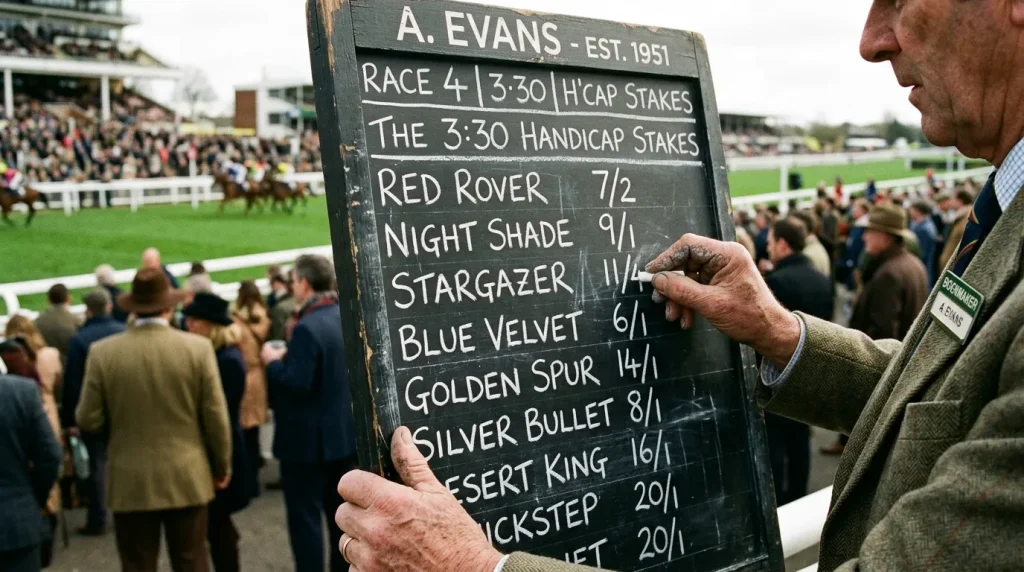
Reading Fractional Odds: Calculating Exotic Bet Returns
Understanding horse betting odds is the prerequisite for everything that follows — exotic bets, wheel strategies, form analysis, bankroll management. None of it makes sense if you cannot read the numbers next to a horse’s name on the racecard and translate them into what you stand to win, what probability the market assigns to that outcome, and how the price compares with your own assessment.
The UK uses fractional odds as its default format. You will see them on the racecard, on the betting ring boards at the course, and on every bookmaker’s app. They look like fractions — 5/1, 11/4, 6/4, 4/9 — and they tell you the ratio of profit to stake. This guide decodes the format, shows how to convert it to decimals for calculation, works through return examples, and explains how odds connect to the exotic bet payouts that form the core of wheel betting.
Reading Fractional Odds: 5/1, 11/4, 6/4
A fractional odd like 5/1 (spoken as “five to one”) means that for every £1 you stake, you receive £5 in profit if you win, plus your £1 stake returned. Total return: £6. The number on the left is profit; the number on the right is the stake required to generate that profit.
At 11/4 (“eleven to four”), you receive £11 profit for every £4 staked. A £4 bet returns £15 — £11 profit plus the £4 stake. If you prefer to think in £1 terms: divide 11 by 4 = £2.75 profit per £1, for a total return of £3.75.
At 6/4 (“six to four”), the profit is £6 for every £4 staked, or £1.50 per £1. Total return per £1: £2.50. This is a short-priced horse, considered a strong contender by the market.
At 4/9 (“four to nine”), the horse is odds-on — the market believes it is more likely to win than lose. You must stake £9 to win £4 profit. Per £1, that is 44p profit and a total return of £1.44. Odds-on horses are the strongest fancies in the market, and they carry implied probabilities above 50%.
Implied Probability
Every set of odds implies a probability — the market’s estimate of how likely the horse is to win. The formula is:
Implied probability = stake ÷ (stake + profit) × 100
At 5/1: 1 ÷ (1 + 5) × 100 = 16.7%. At 6/4: 4 ÷ (4 + 6) × 100 = 40%. At 4/9: 9 ÷ (9 + 4) × 100 = 69.2%.
Favourites in UK horse racing win approximately 30 to 35% of the time, according to analysis of BHA data. That success rate corresponds roughly to odds of 2/1 to 6/4. If a horse is priced at 6/4 (implied probability 40%), the market is saying it wins more often than the average favourite. If it is priced at 5/2 (implied probability 28.6%), the market considers it less reliable than the typical favourite — but still a serious contender. Understanding the relationship between price and probability helps you assess whether a horse is overbet (shorter than its real chances justify) or underbet (longer than it should be).
Converting to Decimal and Calculating Returns
Decimal odds are the standard format used in continental Europe and on betting exchanges. They express total return per unit staked, including the stake. Converting from fractional to decimal is simple:
Decimal odds = (numerator ÷ denominator) + 1
At 5/1: (5 ÷ 1) + 1 = 6.00. At 11/4: (11 ÷ 4) + 1 = 3.75. At 6/4: (6 ÷ 4) + 1 = 2.50. At 4/9: (4 ÷ 9) + 1 = 1.44.
Decimal odds are easier to calculate returns with because you simply multiply the decimal by your stake. A £10 bet at 3.75 returns £37.50 (£10 × 3.75). No separate profit-and-stake calculation needed.
Worked Return Examples
A £5 win bet at 9/2 (decimal 5.50): return = £5 × 5.50 = £27.50. Profit = £22.50.
A £10 win bet at 3/1 (decimal 4.00): return = £10 × 4.00 = £40.00. Profit = £30.00.
A £2 win bet at 33/1 (decimal 34.00): return = £2 × 34.00 = £68.00. Profit = £66.00.
For each-way bets, calculate the win half and the place half separately. The place odds are the fractional odds divided by the place terms (typically 4 or 5). A £5 each-way at 10/1 with quarter-the-odds place terms: win half = £5 × 11.00 = £55; place half = £5 × 3.50 = £17.50. If the horse wins, you collect both: £72.50 total. If it places but does not win, you collect only the place half: £17.50.
How Odds Relate to Exotic Bet Payouts
Exotic bet dividends — the CSF for forecasts, the CST for tricasts, and Tote pool dividends — are all influenced by the odds of the horses involved, but they are not simple multiplications of those odds. Understanding the connection helps you estimate whether an exotic bet offers value before you place it.
The CSF uses starting prices of the first and second finishers to produce a dividend via a standardised formula. Broadly, the CSF increases as the starting prices of the finishing horses increase. Two short-priced horses filling first and second produces a low CSF — perhaps £5 to £15. A 5/1 winner followed by a 12/1 runner-up produces a CSF in the range of £50 to £90. A 10/1 winner with a 25/1 runner-up can push the CSF above £200.
The CST follows the same logic with a third horse added. Because three prices are multiplied into the formula, CST dividends escalate faster than CSFs. A tricast involving three mid-priced horses can easily reach several hundred pounds per £1 stake, and tricasts involving outsiders routinely enter four figures.
Pool dividends — Tote Exacta, Tote Trifecta — behave differently. They depend on the total pool size and the number of winning tickets, not directly on starting prices. However, starting prices and pool dividends tend to correlate: when an unlikely combination wins (involving horses with long odds), fewer people have backed it in the pool, and the dividend per winning ticket is higher. The takeout on exotic pools typically exceeds 20%, according to standard pari-mutuel rate data. That deduction applies before the dividend is declared, so the effective pool available to winners is the total pool minus the takeout.
For the exotic punter, odds literacy means being able to estimate the likely CSF or CST before a race and judge whether the cost of a wheel or combination bet is justified by the expected dividend. If your key horse is 2/1 and the field behind it is compressed between 4/1 and 8/1, the CSF on most winning outcomes will be modest — perhaps £10 to £25. A nine-unit wheel at £1 costs £9, leaving slim margins. But if your key horse is 5/1 and several outsiders at 14/1 or longer lurk behind it, the CSF on an unexpected exacta can be substantial enough to justify the outlay several times over.
Numbers That Mean Something
Fractional odds are not decoration on a racecard — they are compressed information about the market’s view of a horse’s chances. Learning to read them fluently, convert them when needed, and link them to exotic bet payouts transforms odds from background noise into the primary tool for assessing whether a wager offers value. Every exotic bet decision — whether to wheel, how many runners to include, and whether to use the Tote or a bookmaker — begins with understanding the odds of the horses involved.
Sources
- Grand National Fans — favourite win rates and implied probabilities from BHA data: grandnational.fans
- Covers.com — pari-mutuel takeout rates for exotic pools: covers.com
