Exotic Betting Strategies for the Grand National
 Available in US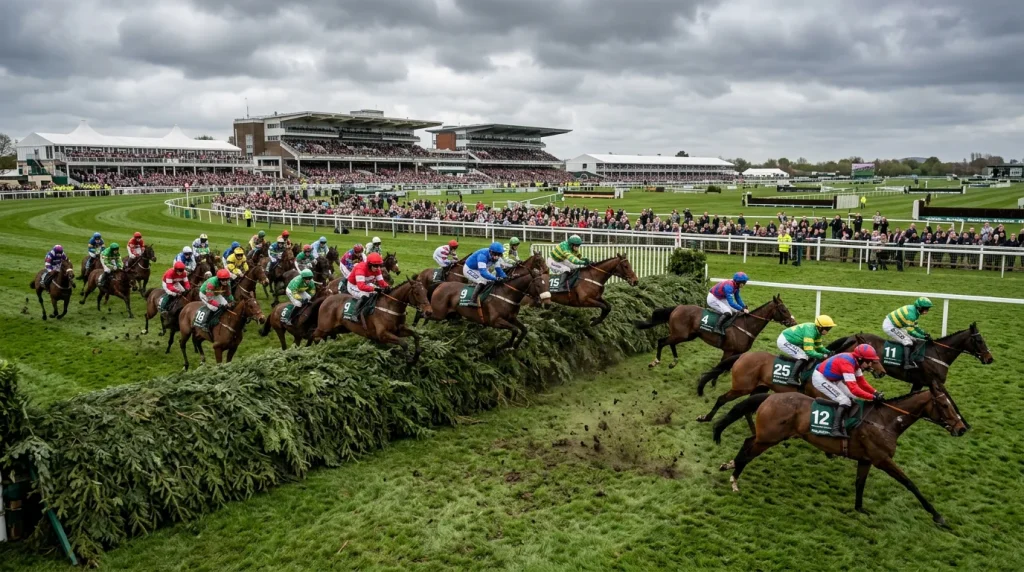
Grand National Exotic Bets: Wheel Strategies for Aintree
A wheel bet on the Grand National is the ultimate test of exotic strategy — and the most punishing environment to get it wrong. Entain’s analysis ranked the Grand National as the single most popular betting event in the world in 2025, ahead of the Super Bowl and the Champions League final. The race was expected to generate more than £200 million in betting turnover, with the entire Aintree festival surpassing £250 million. As Entain Managing Director Greg Ferris observed, the Grand National and the Super Bowl are cultural phenomena that go beyond sport — annual traditions that draw recreational customers who bet on nothing else all year.
That cultural magnetism creates a paradox for the exotic punter. Since 2024, the Grand National field has been capped at 34 runners for safety reasons — down from the previous limit of 40 — but it remains the largest field in UK racing by a wide margin. That scale makes it the most fertile ground imaginable for outsized trifecta and forecast dividends, yet the same field size makes full wheel bets financially impractical. The numbers are simply too large. The solution, as with most things in exotic betting, is precision: partial wheels, pyramid structures, and a clear-eyed understanding of what 34 runners does to combination maths.
34 Runners: Why Full Wheel Is Rarely Practical
Let us start with the maths that limits the full wheel. In a 34-runner race with a single key horse in first position:
Full exacta wheel: 33 combinations. At £1 per combination, that is £33 — manageable, and a reasonable play if you have genuine conviction about a winner in a race where the CSF can easily exceed £100.
Full trifecta wheel: 33 × 32 = 1,056 combinations. At £1 each, that is £1,056. Possible for a punter with a dedicated exotic bankroll, but steep for a single race, even one as valuable as the National.
Full superfecta wheel: 33 × 32 × 31 = 32,736 combinations. At £1 each, that is £32,736. Not viable for any individual punter outside the professional syndicate world.
The cost curve is cubic, and the Grand National’s field size pushes it into territory where partial wheeling is not a luxury — it is a necessity. The question is not whether to narrow your selections but how many to include and where to draw the line.
An exacta full wheel at £33 is the only Grand National wheel that remains accessible at full coverage and £1 stakes. For trifectas and beyond, the partial wheel is the only rational approach. The good news is that partial wheeling on a 34-runner race rewards form analysis more than anywhere else in racing, because every horse you exclude from the wheel saves meaningful money, and every horse you correctly include increases your chance of holding the winning combination in a race where dividends routinely reach four and five figures.
A Partial-Wheel Template for the Grand National
Building a partial trifecta wheel for the Grand National requires three layers of decision-making: identifying your key horse, selecting a short list of contenders for second, and casting a wider net for third.
Layer 1: The Key Horse
Your key horse must be a runner you believe will win. In the Grand National, that means a horse with a proven record over extreme distances (four miles and two furlongs), jumping ability over the unique Aintree fences, and a racing weight that does not cripple its chances. Narrowing the 34-runner field to a single key is difficult but essential — without an anchor, the partial wheel loses its cost advantage.
Layer 2: Second-Place Contenders
Select five to eight horses you consider realistic contenders for the runner-up spot. These should be horses with similar stamina credentials to your key, proven at Aintree or over comparable courses, and well weighted by the handicapper. Keeping this layer between five and eight runners balances coverage against cost.
Layer 3: Third-Place Possibilities
Widen the net for third. Include eight to twelve runners — the five to eight from Layer 2 plus additional horses who might stay on for a place without necessarily threatening to win. Older Grand National hands, consistent stayers, and horses whose form on soft ground suits the typical Aintree conditions are all candidates.
Cost Calculation
With 1 key horse, 6 in second and 10 in third (excluding overlaps where second-place runners also appear in third), the combinations are calculated as follows. Your key is fixed in first. For each of the 6 second-place selections, you pair with each of the remaining third-place selections (excluding the horse already occupying second). If your 10 third-place runners include the 6 second-place runners, the count is: 6 × 9 = 54 combinations (each second-place horse pairs with the 9 others in third). At £1 per combination: £54. At £0.50: £27.
If you extend the third layer to 12 unique horses (6 from the second layer plus 6 additional): 6 × 11 = 66 combinations. At £1: £66. These are serious but not unreasonable amounts for the single biggest race of the year, particularly when the Tote Trifecta dividend on the 2021 Grand National was £35,431 to a £1 stake.
Trifecta and Forecast Scenarios for Aintree
The Grand National generates exotic dividends unlike any other race in the calendar. According to Entain data, the race produces 700% more betting turnover than the next most popular individual race, the Cheltenham Gold Cup. That turnover flows into deep Tote pools, which in turn generate substantial dividends — especially when the finishing order includes a longshot.
Trifecta Plays
The Tote Trifecta is the preferred vehicle for Grand National exotic bets. The pool is deep — fuelled by the race’s cultural status and the volume of casual money that enters the market — and the 34-runner field creates a vast number of possible ordered combinations, most of which will be lightly or unbacked. When the winning combination includes a horse at 25/1 or longer, the Tote Trifecta dividend can reach five figures.
The CST, by comparison, compresses extremes. On the same 2021 Grand National, the CST was £8,593.94 — substantial by any standard, but less than a quarter of the Tote dividend. The message for Grand National exotic punters is clear: use the Tote Trifecta rather than the bookmaker tricast. The pool advantage at Aintree is too large to ignore.
Forecast Plays
A £1 full exacta wheel on the Grand National costs £33 and covers every possible runner-up to your key horse. The CSF on the 2021 National was £882.65, and the Tote Exacta was £2,053.30. Even accounting for the £33 outlay, both figures represent enormous returns. The full exacta wheel is the most accessible Grand National exotic bet and a sensible starting point for punters who are not yet comfortable building trifecta pyramids.
The Race That Rewards the Prepared
Wheel betting on the Grand National is not about covering every possibility — the field size makes that impossible for anything beyond the exacta. It is about applying form analysis, stamina assessment and cost discipline to build a partial wheel that captures the most probable finishing combinations at a price your bankroll can sustain. The dividends are there. The pools are deep. The race is structured to reward the punter who does the work. Build your layers, check your costs, use the Tote, and respect the fact that 34 runners means 34 ways to be wrong — but only one combination needs to be right.
Sources
- NEXT.io — Entain analysis, Grand National as world’s top betting event, Greg Ferris quote: next.io
- UK Bookmakers — Grand National turnover and 700% comparison with Cheltenham Gold Cup: ukbookmakers.org.uk
- Betting Sites Offers — Tote Trifecta vs CST and Tote Exacta vs CSF, Grand National 2021: bettingsitesoffers.com
